- KUBERNETES
- RESEARCH ENVIRONMENT
High Security and High Performance Kubernetes (K8s) in Research Environments
 Dec 29, 2025
-
 Emilia Skonieczna
 -
 10 minutes
 Dec 29, 2025Emilia Skonieczna10 minutes
Research teams need Kubernetes clusters that stay fast, stay stable, and stay secure. When tasks involve sensitive data and heavy computation, ordinary deployments aren't enough. That's why modern research increasingly relies on purpose-built K8s environments designed for both protection and performance.
Research groups are turning to Kubernetes because it handles scalable, containerized scientific workloads with remarkable efficiency. All thanks to the way it coordinates distributed tasks and makes better use of resources across the cluster.
Its strong resource isolation, reproducibility, and elasticity make it ideal for advanced research in demanding fields like bioinformatics, AI/ML, physics, and climate modeling, where compute intensity and complex experimentation require dependable orchestration.
Research environments face different security challenges.
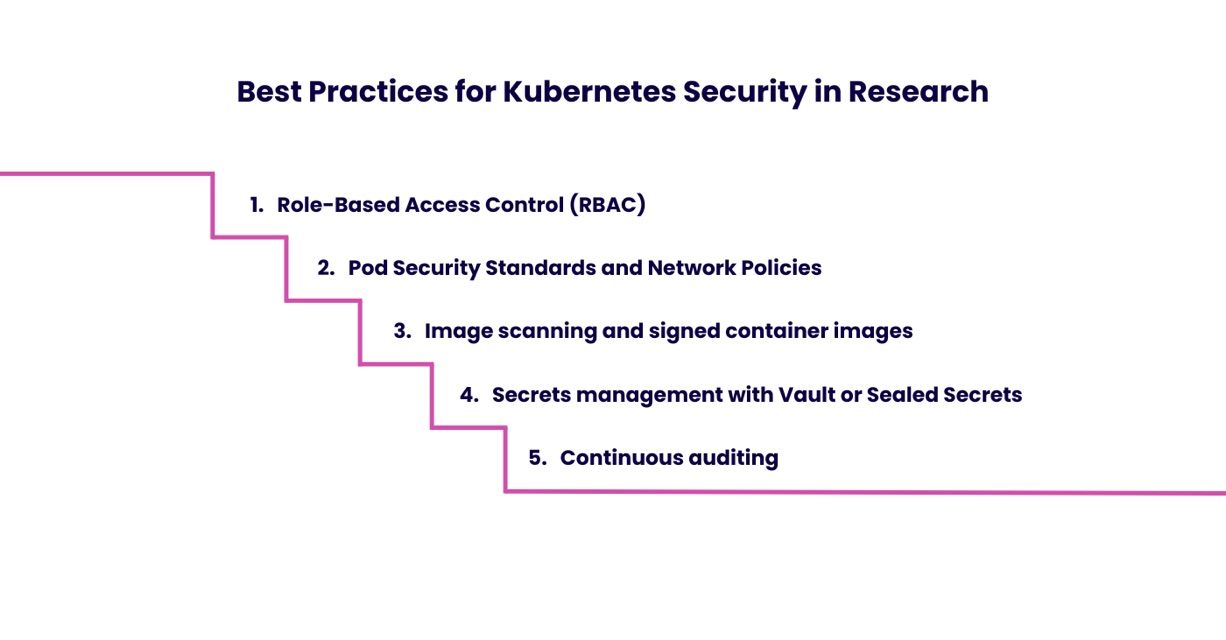
Securing a Kubernetes cluster focuses on protecting sensitive data without slowing anything down. A few practices are especially important:
Role-Based Access Control (RBAC)
RBAC limits user permissions so researchers can access only the namespaces and resources needed for their projects. That way, you reduce the risk of misconfigurations or compromised accounts.
Pod Security Standards and Network Policies
Pod Security Standards block unsafe container behavior (like privileged containers), and Network Policies control how pods communicate within Kubernetes clusters. Together, they improve workload isolation and reduce unexpected cross-communication.
Image scanning and signed container images
Tools like Trivy or Clair scan container images for vulnerabilities before deployment. Signed images then guarantee that the cluster executes only trusted, verified workloads.
Secrets management with Vault or Sealed Secrets
Sensitive credentials are stored securely instead of being placed directly in Kubernetes manifests. Vault centralizes secret storage and rotation, and Sealed Secrets makes it possible to version encrypted secrets safely.
Auditing with tools like Falco or KubeAudit
Continuous auditing helps detect unusual activity or insecure configurations within the Kubernetes cluster. Falco monitors runtime behavior for suspicious events, and KubeAudit checks cluster resources against recommended security practices.
High-performance research setups often begin with GPU and CPU resource tuning for ML training or simulations to ensure that jobs receive the exact compute profile they need without wasting cluster capacity. Workloads can be separated effectively through the use of node affinity and taints for workload segregation, which keeps specialized nodes dedicated to the right tasks.
Scaling efficiency plays a major role as well. Kubernetes supports both horizontal and vertical approaches, and choosing the right mix of their pod autoscaling strategies helps maintain performance as demand shifts.
Research pipelines rely heavily on data throughput - that's why you need persistent storage and data I/O optimizations (e.g., Ceph, CSI drivers). They help minimize bottlenecks and keep jobs running at full speed.
Research teams often extend their Kubernetes clusters with tools that strengthen security, improve performance, and provide better visibility into how the system behaves. The right mix of them help maintain a balanced combination of performance and security.
Tools like OPA/Gatekeeper, Kyverno, and Kube-bench play a central role in improving Kubernetes security by enforcing consistent policies across the cluster, validating configurations, and checking compliance with established benchmarks.
They help teams address configuration drift and reduce potential security risks in sensitive research environments.
For compute-heavy tasks, people often rely on solutions that enhance Kubernetes performance. Each tool targets a different performance need. For example, KubeVirt makes it possible to run VMs alongside containers, Volcano optimizes scheduling for batch and HPC-style jobs, and the NVIDIA GPU Operator simplifies GPU management across nodes running on Kubernetes.
Observability is necessary in any Kubernetes environment. A standard monitoring stack built on Prometheus + Grafana, supported by Kube-state-metrics, offers deep visibility into cluster health, resource usage, and workload behavior.
This helps quickly diagnose performance bottlenecks or capacity issues.
CNI solutions like Cilium and Calico are critical networking components of Kubernetes. They improve security and performance by enforcing network policies at the pod level, optimizing traffic paths, and providing visibility into network traffic.
They make it possible to control which workloads can communicate, track how traffic flows between pods, and diagnose network-related performance issues during large-scale experiments.
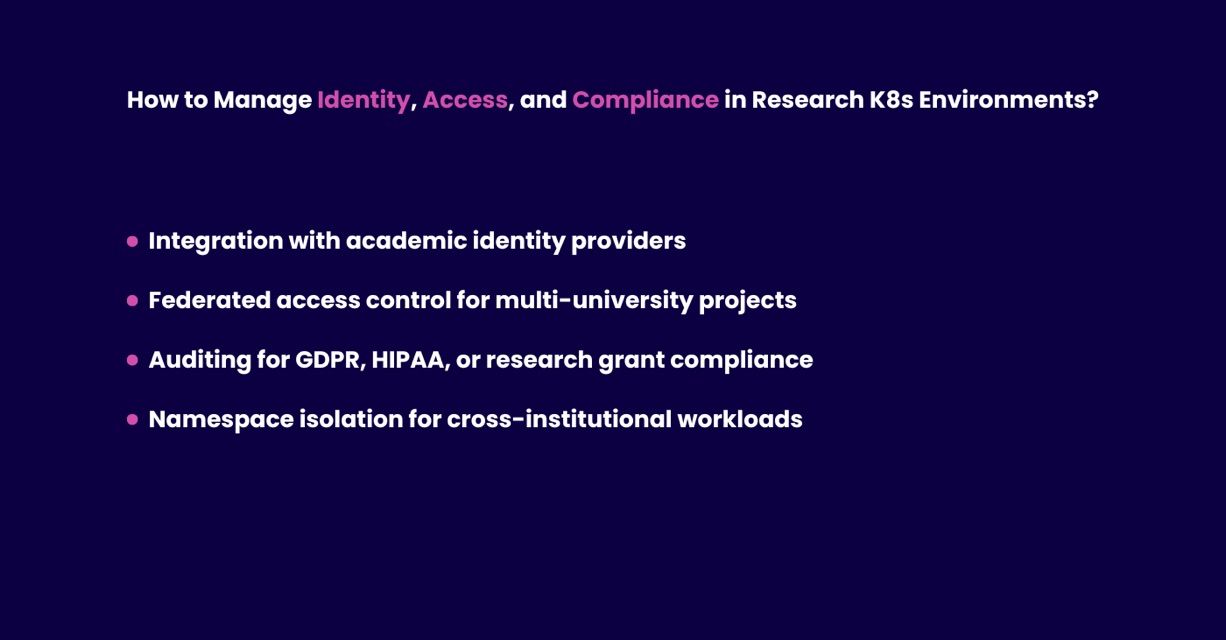
Managing identity, access, and compliance requires approaches that support cross-institutional collaboration and maintain clear security boundaries and auditability.
Integration with academic identity providers
Kubernetes clusters used for research are commonly integrated with academic identity providers. Using standards like SAML, LDAP, or OAuth allows researchers to authenticate with institutional credentials, reduces manual account management, and simplifies onboarding and offboarding as project memberships change.
Federated access control for multi-university projects
Large research initiatives often involve collaborators from multiple institutions. Instead of managing permissions on a per-user basis, access can be granted through organizational or group membership, enabling consistent authorization policies across participating organizations.
Auditing for GDPR, HIPAA, or research grant compliance
Compliance requirements add another layer of complexity. Recording authentication events, API actions, and configuration changes helps meet obligations related to GDPR, HIPAA, or grant requirements.
Namespace isolation for cross-institutional workloads
By separating workloads, data, and access policies at the namespace level - combined with RBAC and network policies - research teams can safely run experiments from different institutions on the same cluster without risking unintended access or data leakage.
Kubernetes is increasingly used in research where scalability must be combined with strict data protection and controlled access. Below are some use cases that demand both strong security and high performance.
Genomic sequencing pipelines (bioinformatics)
Genomic sequencing pipelines, a core use case in bioinformatics, process large genomic datasets and are often subject to strict privacy requirements. Kubernetes allows these pipelines to scale horizontally across compute nodes and maintain strong isolation between workloads.
Secure namespaces, encrypted storage, and controlled access help protect data confidentiality. Optimized scheduling and parallel execution keep analysis pipelines fast and reproducible.
Real-time sensor data processing (IoT and edge research)
Projects based on live sensor streams - like environmental monitoring, smart infrastructure, or industrial experimentation - require low latency and reliable ingestion of continuous data.
When data is processed partly at the edge and partly in central clusters, maintaining consistent security and performance becomes difficult. Kubernetes brings order to this setup by managing how these workloads are deployed, isolated, and scaled as sensor traffic changes.
Federated machine learning (secure medical data training)
Federated learning allows models to be trained across multiple institutions without sharing raw data. Kubernetes provides the orchestration layer needed to coordinate training jobs, manage secure communication between nodes, and define clear access boundaries.
This makes it possible to train high-quality models while meeting data protection requirements and institutional policies.
Climate modeling and simulation workloads
Climate research and simulation workloads push compute and storage systems to their limits. Kubernetes helps organize them through batch scheduling, resource-aware placement, and scalable storage integration.
Strong isolation and auditing mechanisms reduce the risk of interference between experiments and help keep shared research infrastructure stable during long-running simulations.

Poorly configured Kubernetes clusters can quickly become a serious risk - not only to security, but also to cost efficiency and research continuity. In research environments, where workloads are complex and data is often sensitive, the impact of misconfiguration is amplified. The most common risks include:
Data leakage through insecure Ingress or public services
Misconfigured Ingress controllers, overly permissive Load Balancers, or unintentionally exposed services significantly increase the attack surface. This is especially dangerous for regulated datasets (like medical or genomic data), where even read-only exposure may violate compliance requirements and lead to legal consequences.
Container breakout and privilege escalation
Running privileged containers, mounting host paths, or relaxing security controls for the sake of convenience can open the door to container breakout. While these configurations are rarely malicious, they often emerge from attempts to make things work faster. If exploited - or triggered by faulty workloads - they may allow one workload to interfere with others or even compromise entire nodes, breaking isolation between projects.
Over-provisioning or underutilization of nodes
A lack of clear resource requests, limits, and scheduling policies often results in wasted compute capacity. Some jobs consume far more resources than necessary, while others remain idle. Over time, this imbalance reduces overall throughput and makes infrastructure costs difficult to justify.
Budget loss due to inefficient autoscaling
Improper autoscaling configurations can silently drain budgets. Clusters may aggressively scale up during workload spikes but fail to scale down once jobs finish. This leads to unnecessary node hours, inflated cloud bills, and fewer funds available for actual scientific work.
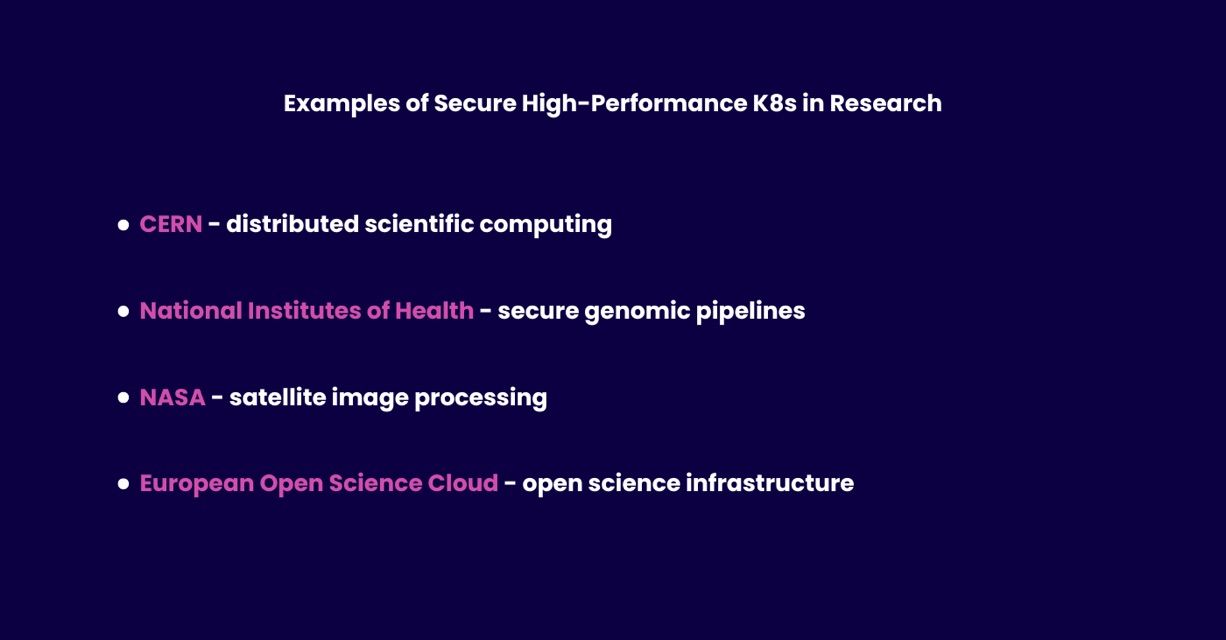
Several major research organizations rely on Kubernetes to combine high performance with strong security guarantees.
CERN - distributed scientific computing
CERN uses Kubernetes to manage large-scale pipelines that support particle physics experiments. The platform enables high-performance workloads for thousands of researchers while maintaining strong isolation between projects and teams.
National Institutes of Health - secure genomic pipelines
The NIH uses Kubernetes to process genomic and biomedical data under strict security and compliance requirements. This approach enables scalable data analysis while protecting sensitive patient information from unauthorized access.
NASA - satellite image processing
NASA applies container orchestration to process massive volumes of satellite and Earth observation data. Kubernetes provides scalability and fault tolerance for data-processing workflows used in space and climate research.
European Open Science Cloud - open science infrastructure
EOSC builds a shared, federated research infrastructure. Kubernetes enables standardized, secure, and reproducible scientific workloads across participating institutions.
Kubernetes has become a key platform for modern scientific computing, and its role in research environments is expected to grow further.
Zero-trust Kubernetes for sensitive data projects
As research projects increasingly involve confidential or regulated data, Kubernetes clusters are being built around zero-trust security models. This approach assumes no implicit trust between workloads and relies on strong identity verification, mutual TLS, granular access controls, and continuous policy enforcement for every interaction within the cluster.
Integration with AIOps for self-healing clusters
The adoption of AIOps is making Kubernetes environments more resilient. By applying machine learning, clusters can proactively identify anomalies, predict failures, and support automated workflows for addressing performance or security issues. This significantly reduces interruptions during long-running or resource-intensive experiments.
Serverless and function-based K8s workflows
More research teams are experimenting with serverless tools built on top of Kubernetes to execute short, on-demand tasks. These lightweight, event-driven workflows are well suited to exploratory analysis and bursty workloads, enabling more efficient use of resources without the overhead of managing long-lived services.
Increasing adoption in multi-cloud and sovereign cloud environments
To meet regulatory obligations and funding requirements, research institutions are deploying Kubernetes across hybrid, multi-cloud, and sovereign cloud infrastructures. This allows them to maintain consistent security standards and performance policies while retaining control over data location and compliance.

Discover how to implement Kubernetes Pod Disruption Budgets (PDB) to manage disruptions, ensure high availability, and maintain your cluster effectively.

Explore how to use Kubernetes for DevOps, from deploying and scaling containerized applications to enhancing your CI/CD pipeline with effective container orchestration.

Boost your DevOps skills with best practices in agile project management, continuous integration, automation, and deployment. Discover the importance of DevOps today!
