- CLOUD MIGRATION
- DIGITALOCEAN
- FINTECH
DigitalOcean Migration for Finance Companies
 Dec 4, 2025
-
 Emilia Skonieczna
 -
 5 minutes
 Dec 4, 2025Emilia Skonieczna5 minutes
Every company needs infrastructure that's scalable, secure, and won't destroy the budget. That's why choosing the right cloud provider is such an important part of any tech strategy. For high-stakes industries like finance, this matters even more - they operate under strict regulations, handle sensitive data, and depend on systems that simply can't fail.
Teams are taking a closer look at DigitalOcean. Let's see why finance companies are considering it and what makes it a strong fit.
Finance companies are moving to DigitalOcean for several reasons. Many are under pressure to modernize and accelerate their digital transformation, and traditional on-premise systems often hold them back with high costs, limited agility, and reliability challenges.
Regulatory expectations around data governance are also increasing, pushing teams toward cloud environments that support compliance and offer strong security defaults - something DigitalOcean provides well.
By using cloud-native architecture on DigitalOcean, finance organizations gain a competitive advantage - they can deploy faster, scale efficiently, and focus more on delivering value rather than maintaining infrastructure.
So what exactly makes DigitalOcean a strong choice for financial institutions? The main benefits include:
High availability and resilient infrastructure that supports always-on financial services.
Certified infrastructure (SOC2, ISO 27001, PCI) that assists customers in meeting their compliance obligations.
Strong security capabilities, including VPC, IAM, encryption, and firewalls.
Scalable compute resources that can handle demanding financial workloads.
An ecosystem of automation, data, and analytics tools that support operations.
Many cloud providers offer similar benefits, but what sets DigitalOcean apart is its simplicity, predictable pricing, and ease of use - especially for teams that don't need the heavy complexity of hyperscale clouds.
DigitalOcean supports several workload types. Finance companies usually move:
Core finance and payment platforms
Lightweight transaction systems, billing services, and payment components that need clean, predictable performance.
Data warehousing and real-time analytics
ETL pipelines that collect financial data, update dashboards, and keep reports up to date.
Client-facing web and mobile applications
Customer portals, banking dashboards, and mobile backends that must stay fast and responsive.
Risk modeling and fraud detection workloads
Scoring engines or batch-processing jobs that benefit from the ability to scale resources up or down as needed.
KYC/AML and document processing systems
Identity verification tools and document-processing workflows that handle sensitive customer data.
Lift-and-shift into Droplets and VPC - moving existing applications as they are, deploying them on Droplets and isolating them with VPC to match on-premise security patterns.
Refactoring into microservices - breaking a monolithic application into smaller services and running them on DigitalOcean Kubernetes for easier scaling and independent deployments.
Hybrid and phased transitions - migrating workloads in stages, keeping some systems on-premise or in another cloud until full cutover is possible and compliance checks are complete.
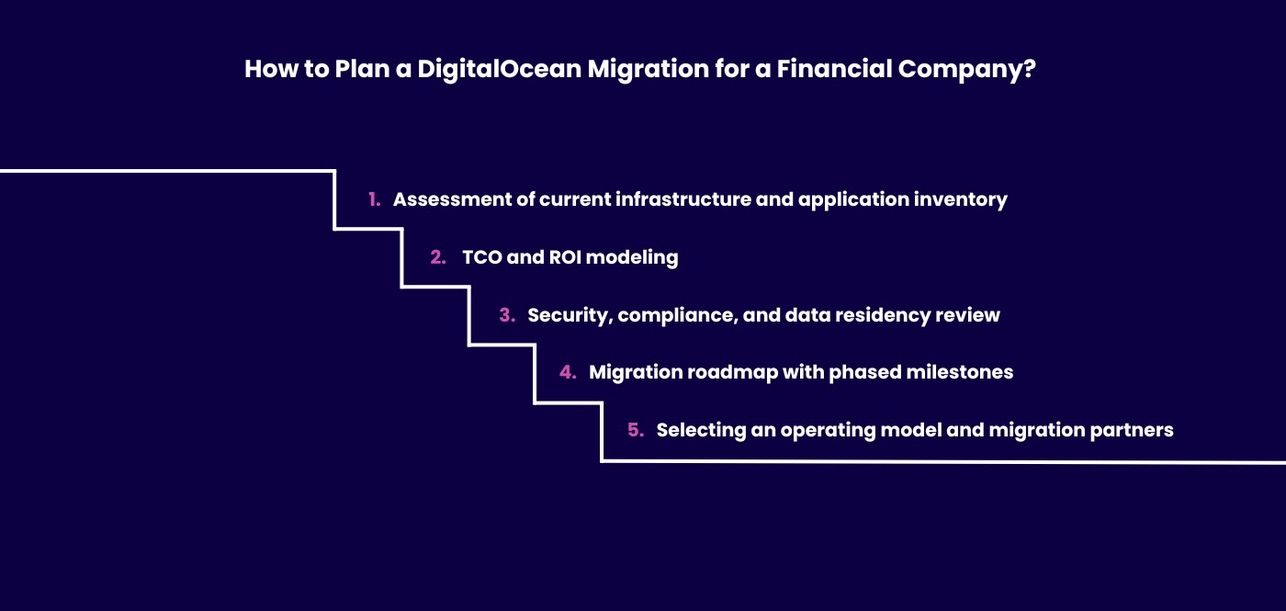
Planning a cloud migration in a regulated environment requires structure and clear checkpoints. Common steps include:
Assessment of current infrastructure and application inventory
Understanding what exists today - systems, dependencies, data flows, and performance requirements - helps determine what can move and what needs adaptation.
TCO and ROI modeling
Comparing current infrastructure costs with estimated expenses on DigitalOcean to understand the financial impact of the migration.
Security, compliance, and data residency review
Checking regulatory requirements (like SOC 2, ISO 27001), data management rules, encryption needs, and residency expectations to ensure the new environment aligns with governance standards.
Migration roadmap with phased milestones
Building a step-by-step plan that defines which workloads should move first, what testing is required, and how cutovers will be handled.
Selecting an operating model and migration partners
Deciding who will manage the environment post-migration and choosing internal teams or external partners to support the migration.
Maintaining security and compliance during a migration is necessary. But how do you achieve it?
It requires applying strong controls at every stage of the process. This includes:
implementing IAM and role-based access controls to limit who can access sensitive systems
applying encryption at rest and in transit to protect financial data
using VPC segmentation and firewall policies to isolate workloads and restrict network exposure
Teams should also rely on continuous monitoring and configuration auditing to identify misconfigurations early and maintain operational integrity.
Lastly, the entire migration must align with industry regulations such as GDPR, PCI, and SOX, so data processing, logging, and governance practices meet required standards.
Risk mitigation in financial migrations requires a careful and controlled plan rather than a single action. One of the most effective ways to achieve this is through pilot migrations and parallel-run strategies, which give teams the ability to test workloads in the new environment without affecting production. Strong backup and rollback planning is equally important, so critical systems can be restored quickly if any issues occur during the cutover.
Once the migration is complete, companies should perform post-migration validation of workloads to confirm that performance, security, and data processes meet expectations. In highly regulated environments, organizations also benefit from engaging certified DigitalOcean specialists or third-party auditors who can verify that the migration aligns with internal and external compliance requirements.

The transformative power of cloud migration: lower costs, enhanced scalability, and operational efficiency. Start saving now!


Most SaaS cloud problems start with early decisions. Cloud consulting helps you scale safely, control costs, and build resilient infrastructure from day one.

Kubernetes has become a core solution for secure, high-performance scientific research and data-intensive computing. This article outlines the key reasons behind this.
